Police Simulator: Police Games
- 4.6
- Rating
- 50.00M
- Installs
- Free
- Price
 Analysis by App-foxy
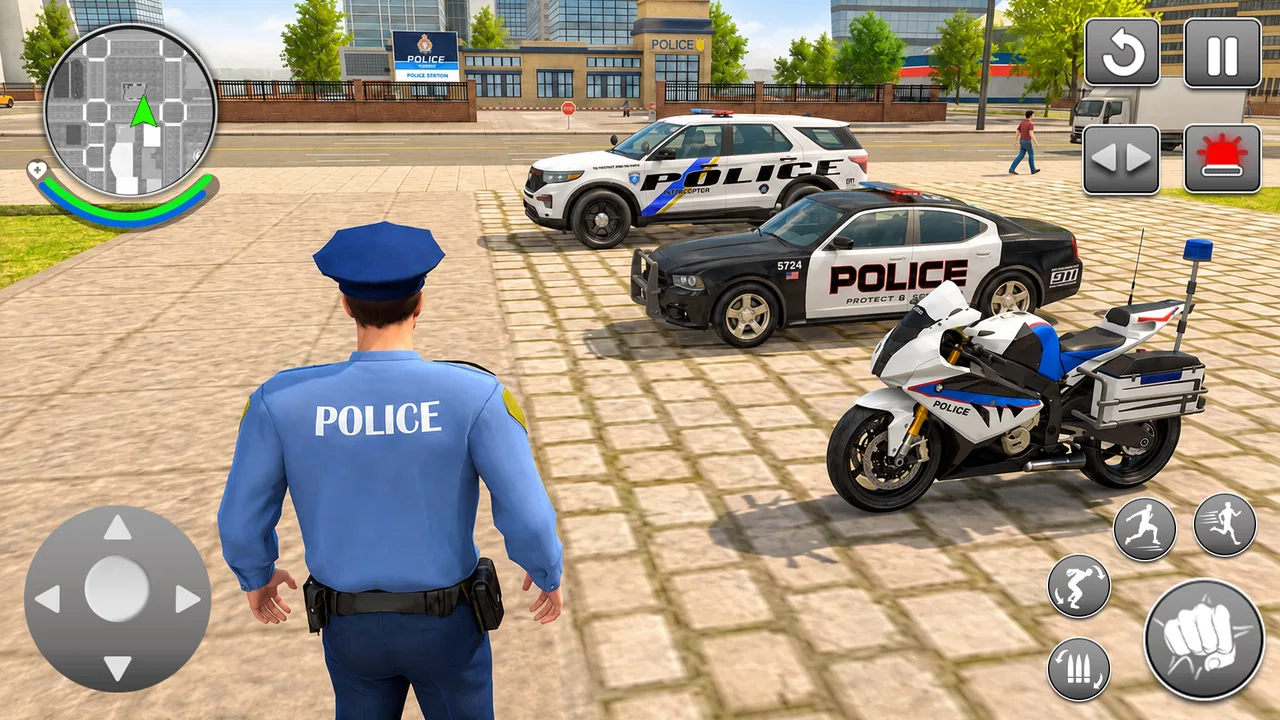
Police Simulator: Police Games is the kind of mobile game I open when I want a quick change of pace rather than a deep, carefully structured simulation. It puts me behind the wheel of a police car, lets me ride a police bike, and adds a flying police helicopter to the mix. That combination gives it a broader feel than a simple driving game, although the experience is still best understood as casual simulation entertainment rather than a serious training tool.
After spending time with it, I found the main appeal easy to understand: you can switch between different police-themed vehicles and imagine yourself handling patrol duties from several viewpoints. The first few minutes are especially approachable because the basic fantasy is immediately clear. You are not learning a complicated professional system; you are taking control, moving through the environment, and trying to complete police-style activities without getting lost in a long tutorial.
The game is free, belongs to the simulation category, and is made by GamePark. Its Teen content rating is worth noticing before installing it for a younger player. It has also attracted a large audience, with more than fifty million installs and an average score of 4.6 from roughly eighty-nine thousand ratings. Those figures suggest that the straightforward police role-play has found a wide audience, but they do not remove the need to decide whether its casual style matches what you personally want.
You May Also Like

 Blood Strike: 2.5 Anniversary
Blood Strike’s Loadouts Turn Every Drop Into a Tactical Gamble
A close look at Blood Strike’s custom loadouts: how fast access to signature weapons reshapes its battle royale rhythm, rewards preparation, and narrows the gap between fights.

 Pandora - Music & Podcasts
Pandora’s Music Is Easy to Start, but Harder to Recover
Pandora’s strength is its low-effort path from a seed to a station. Its weak spot is how much confidence it asks you to place in connection, setup, and quiet recovery.

 8 Ball Pool
 Is Built on Rivalries, Rematches, and Routine
A close look at the rivalries, rematches, shared routines, and unanswered safety questions that turn a quick pool match into a persistent mobile community.

 Samsung Music
’s Quiet Strength Is Playing What You Already Own
Its reach comes less from spectacle than from dependable access to a personal library. That simplicity is both the app’s strongest retention engine and its ceiling.

 AccuWeather: Weather Radar
AccuWeather Review: A Quick, Clear Forecast for Everyday Decisions
For everyday plans, the best forecast is the one you can understand quickly. AccuWeather makes rain timing, radar, and local conditions easy to act on, with a few trade-offs.

 Hill Climb Racing
Why Hill Climb Racing Still Turns Crashes Into One More Run
A tiny car, a bumpy hill and one more upgrade: Hill Climb Racing keeps resurfacing because its simple chaos makes every near-miss feel personal.
More From Our News Desk
View All News


What the first session feels like
My advice is to approach this as a vehicle-focused police fantasy. The strongest moment is not necessarily completing a long chain of objectives; it is choosing a vehicle, getting moving, and seeing how the controls feel in practice. The police car is the natural starting point because it gives the most familiar perspective. Once I understood how movement worked, the police bike offered a different rhythm, while the helicopter changed the sense of scale and made the session feel less like ordinary road driving.
That variety is the game’s clearest strength. A standard police driving title can become repetitive when every activity happens from the same seat. Here, changing vehicle gives you a reason to return to the same general idea with a different kind of control. The car feels suited to ordinary patrol-style movement, the bike makes navigation feel more exposed and nimble, and the helicopter is the option I would choose when I want the most unusual viewpoint.
At the same time, I would not install it expecting the detailed rules, realistic procedures, or layered decision-making of a premium simulation. The store short description calls it a police simulator, but the enjoyable part is the accessible role-play rather than strict realism. That distinction matters. If you want to relax with a police-themed driving game, it can be a pleasant choice. If you want a highly authentic law-enforcement simulator with complex casework, radio communication, evidence handling, or a carefully modeled career, this is probably not the right destination.
The game works best in short sessions. I can imagine opening it while waiting for an appointment, taking a car or bike out for a few minutes, and stopping once the novelty of that session has faded. The helicopter is useful when the road-based view starts to feel familiar, because it gives the experience a fresh visual angle. I would treat the three vehicles as separate ways to refresh the same basic fantasy, not as three entirely different games.
Setting up without overthinking it
The technical entry point is relatively broad because the game supports Android devices running version 7.0 or later. The current version is 3.4.1, so I would check that the device is updated enough before trying to install it. Since it is free, the initial decision is simple: install it, test the controls, and decide from the first session whether the handling and presentation suit you.
When I begin a game like this, I prefer not to rush into every available vehicle immediately. Starting with the car makes it easier to learn the relationship between steering, acceleration, braking, and the surrounding space. Even if the game presents the options quickly, spending a little time with one vehicle helps separate control problems from unfamiliarity. If the car feels comfortable, the bike and helicopter become experiments instead of sources of confusion.
A practical first-session routine is to choose the police car, move slowly at first, and use open space to test turning and stopping. I would avoid trying to drive aggressively before understanding how much room the vehicle needs. In a mobile simulation, a small mistake can feel larger when the camera, steering, and speed are all new at once. Learning the basic movement at a calm pace makes the later change to the bike much less frustrating.
The police bike deserves a separate adjustment period. A bike often feels more sensitive than a car because the narrower shape changes how you judge gaps and turns. I found it more useful to think of it as a precision vehicle rather than simply a faster car. Use it when you want a more active ride, but do not assume that speed alone will make progress easier. If you are repeatedly missing turns or colliding with the environment, slowing down is usually a better solution than trying to compensate with more aggressive steering.
The helicopter is the biggest mental change. Aerial movement can make familiar landmarks look different, and the distance from the ground can make it harder to judge where you are going. I recommend treating the first flight as orientation rather than a mission to finish quickly. Look for recognizable areas, learn how the camera communicates height and direction, and only then try to move with purpose. This is one of the game’s less obvious trade-offs: the helicopter provides variety, but it may also require the most patience from a first-time player.
Finding the first meaningful success
For me, the first real success is not simply starting the engine. It is completing a short stretch of movement without losing control, then deliberately reaching the next point or activity instead of wandering. That small goal gives the game structure. I would begin by choosing one vehicle, traveling carefully, and treating successful navigation as the first milestone. Once that feels natural, try the same idea with the bike and compare how your decisions change.
This approach is reassuring because it avoids the common mistake of measuring the game only by speed. Police-themed games can encourage players to drive as quickly as possible, but quick movement is not always useful. A controlled turn, a clean stop, or an accurate arrival can be more satisfying than a dramatic crash or a reckless shortcut. I found that the game becomes more enjoyable when I create these small objectives for myself instead of expecting every moment to provide a major event.
A realistic everyday scenario would be a short evening session after work or school. I might select the car, spend a few minutes patrolling, switch to the bike for a change of pace, and finish with a brief helicopter flight. That sequence gives each vehicle a purpose without demanding a long commitment. It also helps reveal which style I actually enjoy. Some players will prefer the grounded feel of the car, while others will return mainly for the aerial perspective.
Another useful habit is to change only one thing at a time. If you switch vehicle, camera behavior, and driving style all at once, it becomes difficult to know why a session feels awkward. I usually learn the car first, then compare the bike, and save the helicopter for when I want a clearly different experience. This is a simple workflow, but it makes the game feel more manageable and gives a first-time player a clear path from installation to a successful session.
The best early goal is controlled progress, not maximum speed. That mindset is particularly helpful here because the appeal comes from pretending to carry out patrol-style duties. Driving carefully supports that fantasy better than treating every road as a race track. It also reduces the frustration that can come from oversteering, missing a turn, or losing awareness of the environment.
Confusion points that can affect enjoyment
The first source of confusion is the word “simulator.” In everyday app-store language, it can refer to anything from a detailed professional recreation to a light role-playing game. I place this title closer to the accessible end of that range. It gives you police vehicles and a police setting, but I would not use it to judge how real police work operates. The game’s value is imaginative play, vehicle variety, and quick access rather than procedural depth.
The second issue is repetition. The car, bike, and helicopter provide welcome changes, but they do not automatically create unlimited variety. After the initial excitement, the same movement and patrol-style loop may begin to feel familiar. This is where self-directed play matters. Setting a small route, practicing a difficult turn, or switching vehicles with a specific purpose can stretch the experience. Without that personal structure, a player looking for constant new missions may lose interest sooner.
Camera and movement can also influence whether the game feels comfortable. A viewpoint that seems fine in the car may feel less intuitive on the bike or in the helicopter. Instead of assuming that the vehicle is poorly designed, I would give each one a few minutes and use slower movements while learning. The helicopter in particular benefits from patience because aerial travel changes how you read distance. If you prefer games with immediately obvious controls and little adjustment, the car is the safer choice.
The Teen rating is another reason to consider the intended player before handing over a device. I would not treat the title as automatically suitable for every child simply because the controls are easy to understand. Parents should make their own decision based on the rating and the player’s age. For teenagers and adults who enjoy police-themed vehicle play, the rating should at least make the intended audience clearer.
It is also important to understand what the game is not replacing. It is not a substitute for a realistic driving lesson, and it is not comparable to a console or PC simulation built around detailed physics and long-form progression. Compared with a typical racing game, it gives up competitive speed and track-focused precision in favor of police role-play. Compared with a serious simulator, it is easier to enter but less demanding and less comprehensive. Its middle ground is both its advantage and its limitation.
Choosing between the three vehicles
I would choose the police car when I want the most stable starting point and the clearest sense of a normal patrol. It is the best option for learning the environment because the perspective feels familiar. It also suits a player who likes making deliberate routes and observing the surroundings rather than constantly changing direction.
The police bike is better for players who want movement to feel more active. It can make a short session feel different even when the general objective is similar. My tip is to use it after learning the car, not before. Once you understand the layout and how much space turns require, the bike becomes a deliberate challenge rather than a confusing first impression.
The helicopter is the choice for variety and perspective. It changes the visual relationship between the player and the world, which can make the game feel new again when ground driving becomes routine. I would recommend it to anyone who enjoys exploring from above, but I would not call it the easiest vehicle for a first meaningful success. Learn its movement gradually, and focus on orientation before trying to travel quickly.
There is a useful trade-off here: the vehicle with the most novelty is not necessarily the one with the smoothest learning curve. The car is the most reassuring introduction, the bike adds a more responsive style, and the helicopter supplies the strongest change of viewpoint. Thinking of them this way helps you pick the right option for your mood instead of assuming that one vehicle is simply superior.
Who should install it, and who should skip it?
I would recommend this game to someone who likes casual mobile simulations, police-themed vehicles, and short sessions with a clear visual premise. It is especially suitable for a first-time player who wants to understand the appeal quickly without reading a long manual. The free price also makes it easy to test, provided the Teen rating fits the intended user and the device meets the Android requirement.
I would be more cautious for players who need deep progression, realistic law-enforcement procedures, competitive multiplayer, or a highly exact driving model. Those players may be happier with a more specialized alternative in the simulation or racing space. Someone who dislikes repetition should also think twice, because the vehicle changes refresh the experience but do not transform its basic identity.
The game’s audience size and 4.6 average indicate strong general appeal, but personal taste still matters more than popularity. A player who enjoys imagining patrol routes may find plenty to like, while someone who wants a tightly designed campaign may find the activity too open or lightweight. I would use the first session as a test of handling and atmosphere rather than assuming the rating guarantees a perfect match.
My recommendation after learning the rhythm
Police Simulator: Police Games is most enjoyable when I keep my expectations in the right place. It is a free simulation game from GamePark built around the simple pleasure of operating a police car, riding a police bike, and flying a police helicopter. The three options give the title a useful amount of variety, and the accessible setup makes it easy for a newcomer to reach the first successful drive without a steep learning curve.
Its weaknesses are equally clear. The police theme does not turn it into a detailed professional simulator, and players who expect endless mission variety may eventually notice the limits of the basic loop. The helicopter adds freshness but can take longer to understand, while the bike rewards careful control more than careless speed. Those are not reasons to dismiss the game; they are reasons to play it according to its strengths.
With the game released on August 28, 2023 and now at version 3.4.1, it has had time to establish a substantial mobile audience. I would start with the car, aim for one calm and successful route, then use the bike and helicopter as focused experiments. That path makes the first session less confusing and helps answer the most important question quickly: do you enjoy the feeling of casual police vehicle role-play?
My final view is positive but measured. It is a good pick for accessible police-themed vehicle play, not for strict realism. If that distinction sounds right to you, the free installation is worth trying. Begin slowly, learn each vehicle on its own terms, and let the game be a compact entertainment experience rather than demanding from it the depth of a full simulation.
FAQs for Police Simulator: Police Games
01What is Police Simulator: Police Games about?
Police Simulator: Police Games is a realistic simulation game where players step into the shoes of a police officer. Players can patrol the streets, respond to emergencies, and handle various law enforcement tasks. The game aims to provide an immersive experience of police work with a blend of action, strategy, and role-playing elements.
02Can I play Police Simulator: Police Games offline?
Yes, Police Simulator: Police Games offers an offline mode, allowing players to enjoy the game without an internet connection. This feature is perfect for those who want to play while commuting or in areas with limited connectivity. However, some features and updates may require an internet connection.
03What devices are compatible with Police Simulator: Police Games?
Police Simulator: Police Games is available on both Android and iOS platforms. It is designed to run smoothly on most modern smartphones and tablets. However, for the best experience, it is recommended to use devices with updated operating systems and sufficient RAM and storage space.
04Are there in-app purchases in Police Simulator: Police Games?
Yes, Police Simulator: Police Games includes in-app purchases. Players can buy virtual currency and items to enhance their gameplay experience. While these purchases can speed up progression, they are optional, and players can enjoy the core features of the game without spending money.
05Is Police Simulator: Police Games suitable for children?
Police Simulator: Police Games is generally suitable for teenagers and older audiences due to its realistic depiction of law enforcement scenarios. The game may include situations involving crime and law enforcement procedures that might not be appropriate for younger children. Parental guidance is recommended to ensure the content aligns with family values.
Pros
- Realistic graphics enhance immersion.
- Wide variety of missions to tackle.
- Interactive city with dynamic events.
- Customizable police vehicles and gear.
- Engaging progression and rank system.
Cons
- Occasional bugs disrupt gameplay.
- Some missions feel repetitive.
- Requires constant internet connection.
- In-app purchases can be tempting.
- Limited tutorial for new players.

Police Simulator: Police Games
Gallery